
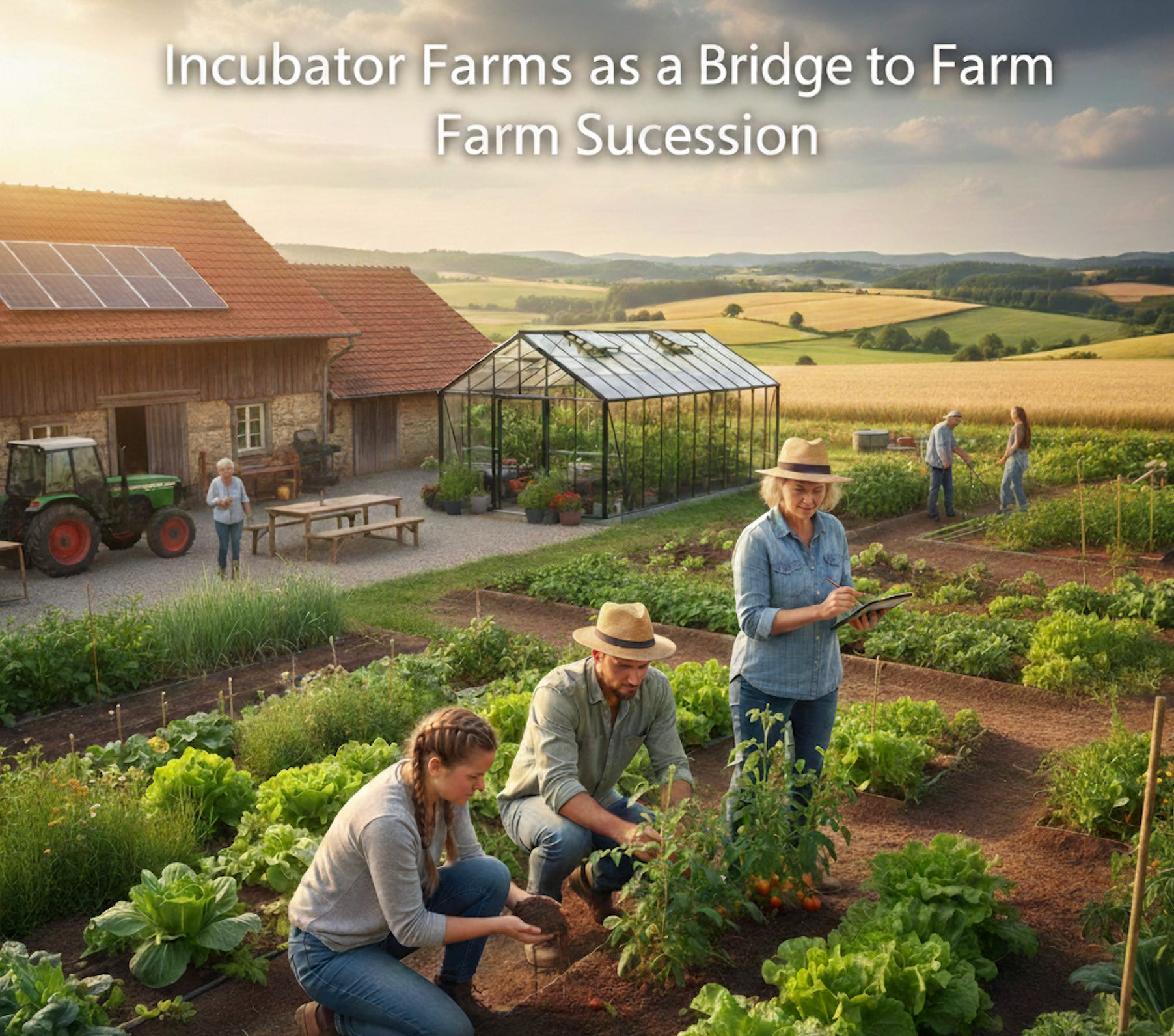
I’m excited to share that I’m starting a new position at Agrarsoziale Gesellschaft (ASG), where I’ll be part of the team coordinating groundbreaking work on agricultural incubator farms in Germany. This represents a crucial intervention in addressing one of the most pressing challenges facing German agriculture: the generational transition crisis.
The Challenge
German agriculture is facing a profound structural transformation. The average age of German farmers exceeds 55 years, and a significant portion of farms need capable successors. At the same time, there are many career changers with agricultural training who want to farm but cannot find their way into farm management. This tension is not an individual problem but rather reflects missing transition infrastructures between education, start-up, and farm succession.
Several pilot projects are currently developing agricultural incubators—test farms for the start-up phase of people without their own farm. Incubator farms provide access to land, infrastructure, mentoring, and markets so that new agricultural business models can be tested under real conditions—without immediate full responsibility, but with clear entrepreneurial autonomy.
The target group consists particularly of career changers with agricultural training who cannot take over their parents’ farm because they didn’t grow up on one. They possess high motivation and professional competence but often don’t dare take the step into agricultural self-employment because structural barriers are very high and there’s a lack of experimental spaces where independent farming can be learned under real conditions.
The French Model
France responded to emerging structural problems in agricultural generational transition nearly two decades ago. It was recognized early that traditional training pathways, one-off start-up grants, and purely investment-related support instruments were insufficient to bring new farm managers into agriculture permanently. The response was the model of Espaces Test Agricole—agricultural incubator farms that enable real but supported entry into self-employment.
Today, France has a nationwide network of more than 80 permanently operated incubator farms. These are regionally organized, embedded in local supporting structures, and closely linked to local agricultural conditions. From this regional practice, the national network RENETA has developed, which doesn’t provide operational management but primarily handles political advocacy, public relations, French experience exchange, and European networking and development of the incubator model.
Several hundred aspiring farm managers go through such an incubation phase annually. A significant portion subsequently start their own farm or take over an existing one; others remain as qualified professionals in agriculture. Incubation is not understood as a protected space but as a real start-up process under conditions that enable entrepreneurial learning without failure becoming immediately existentially threatening.
During the incubation period—up to three years—founders receive access to agricultural land, infrastructure, machinery, consulting and mentoring, and often existing organic certifications. They operate independently, build their own production and marketing structures, and bear responsibility for their business decisions.
To secure existence during phases of low or absent income, there’s the possibility of claiming state benefits to secure minimum subsistence, comparable to French basic income support. These benefits are not offset against agricultural income earned during incubation and can be saved, for example for later business investments. This is not a universal basic income but rather targeted transitional support during the start-up phase.
Legally, incubees are often integrated through a supporting structure or cooperative through which economic activities are organized. Separate accounting ensures that individual farms are managed transparently and founders remain insured.
The incubator model is also specifically used in France for non-family farm transfers. People who want to take over a farm can work on it for several years, gradually assume responsibility, and receive professional and organizational support. Meanwhile, around 50% of all farms transitioning to the next generation in France are transferred outside the family. In Germany, this proportion currently stands below 2%, clearly indicating the considerable structural catching-up needed in transition and support models for farm succession.
Other Countries Implement the French Model
France hasn’t remained alone with this approach. In recent years, other European countries have begun building or adapting similar models. Belgium, Spain, Finland, and other states are experimenting with agricultural incubators, sometimes closely aligned with French models, sometimes regionally adapted.
Common to all these approaches is the recognition that the bottleneck in generational transition lies less in interest in agriculture than in missing transition infrastructures between education, start-up, and farm succession.
Germany, however, lacks a comparable, systematically built incubator system. Individual projects, programs, and consulting services exist, but there’s no coherent structure that realistically enables farm starts without family succession. This is precisely where FarmStarter and Ackerpreneur come in.
Incubator Farms as the Missing Link
Incubator farms close a central gap in the agricultural structural system. They are neither training farms nor traditional consulting formats, but transition spaces where start-ups actually happen. Founders operate independently, build up production branches, make investment and marketing decisions, and gather real entrepreneurial experience. At the same time, they’re embedded in an operational and organizational framework that limits risks and enables learning processes.
Incubator farms have proven effective instruments for enabling start-ups without romanticizing them. Incubation is understood as a real practical test—with the openness that not every incubation must necessarily lead to farm establishment, but nevertheless retains competencies and perspectives in agriculture.
Three Initiatives, One Common Approach
Three currently funded projects exist to realize this vision, formally separate but all pursuing the common goal of establishing incubator farms to enable start-ups and non-family farm succession.
FarmStarter within the WIR!-Elbe-Valley Funding by the Federal Research Ministry (BMFTR)
A project proposal was developed for implementing two incubator farms in Brandenburg and Saxony-Anhalt. Together with ZALF, Agronauten, Agrarsoziale Gesellschaft, the farm “Dachs im Garz” (Julia Bar-Tal), and Warncke Agrar, a consortium was formed to prepare the establishment of these two incubator farms.
One incubator is located on a small-scale vegetable farm where several founders can each cultivate their own plots and greenhouse areas. The second incubator is on a large-scale organic arable farm in Saxony-Anhalt that can provide significantly larger areas and also offers long-term establishment perspectives. In both cases, the goal is to produce under real market conditions, develop independent business models, and build marketing channels.
The aim is to develop regional anchor points from these pilot farms while simultaneously preparing the establishment of a nationwide incubator farm organization.
FarmStarter Hamburg (funded by the City of Hamburg)
FarmStarter Hamburg is a research project funded by the City of Hamburg that examines pathways for farm succession and new entries into agriculture in the Hamburg metropolitan region, with a particular focus on the Vier- und Marschlande.
Similar to experiences from other regional research and innovation contexts, such as the WIR! Elbe Valley, the project explores how supportive structures for farm succession and new agricultural start-ups could be designed under urban and peri-urban conditions. The focus lies on analysis, co-creation and conceptual development rather than on immediate implementation.
Together with agricultural farms, public administration and local initiatives, the project investigates how suitable frameworks for new entrants can be developed that take into account the specific conditions of an urban-influenced agricultural area. Central topics include access to land, operational structures, farmsteads and existing buildings, settlement and land-use pressure, ownership and transfer models, as well as regional value chains and marketing.
FarmStarter Hamburg is implemented as a collaborative research project. Kulturland eG, Agrarsoziale Gesellschaft e.V. and Agronauten e.V. are involved as project partners. The project is led and scientifically coordinated by South Westphalia University of Applied Sciences (Fachhochschule Südwestfalen).
A key outcome of the project is the development of a concept for a “Hamburg model” that brings together research findings and practical experience and may serve as a basis for future pilot projects or follow-up initiatives.
Ackerpreneurs (BMLEH Project)
Ackerpreneurs is an explicitly nationwide pilot project, supported by Landwirtschaftliche Rentenbank and professionally accompanied by the Federal Ministry of Agriculture, Food and Rural Areas. The goal is to systematically define the incubator approach, test it in various regions, and make it transferable. Ackerpreneurs aims to develop a connectable nationwide structure from individual pilot projects and generate insights for the action plan and strategies for generational renewal in agriculture.
The pilot project is coordinated by a network office, supported by Agrarsoziale Gesellschaft e.V. with Netzwerk Flächensicherung e.V. and BioBoden Genossenschaft eG. Scientific research accompanies the work at the University of Hohenheim, and media support for the project is provided by frog, a Capgemini Invent subsidiary.
Different Types of Incubation
The projects show that incubation is not a uniform model. Rather, several types can be distinguished, which can be combined depending on region and farm situation:
Permanent incubator farms that serially host founders and regularly produce new farms
Incubation via new production branches on existing farms, where independent business fields are built within stable operational framework conditions
Accompanied non-family farm succession, where incubation specifically serves as a transition to farm takeover
New establishments on previously unfarmed or no longer farmed land, where incubation enables entry into complete farm development
Common to all types is the aspiration not to simulate start-ups but to enable them in reality.
Target Groups and Prerequisites
Incubator farms explicitly do not target only traditional “young farmers.” Many potential founders bring professional and life experience but lack access to land or capital. This experience can be an important success factor. A prerequisite remains basic agricultural qualification. Incubation doesn’t replace training but builds on existing competencies.
Land Access, Farmsteads, and Transition Economics
Three structural bottlenecks appear particularly evident in almost all projects. First, access to land and especially to farmsteads. This is not solely a question of capital but often shaped by opacity in the land market, missing networks, or lack of local anchoring—particularly for newcomers from urban environments who want to start farms in unfamiliar regions. Second, the economic transition phase of start-up. Especially in the first years, income is often low and volatile while capital requirements are high—significantly more so in agriculture than in most other sectors. Third, there’s a lack of experience in farm management itself. Many founders have professional qualifications but rarely have opportunities to learn and test entrepreneurial responsibility incrementally.
Against this background, FarmStarter and Ackerpreneurs are designed as search processes that open spaces for risk-reduced entry into farm management. Embedded in existing farms, in exchange with experienced farm managers, and supported by regional networks, operational integration, financing, consulting, and social security are connected in ways that enable start-ups and assumption of responsibility without preempting entrepreneurial autonomy.
CAP from 2028: A Strategic Window
With the Common Agricultural Policy from 2028, a new political environment emerges. The EU Commission now requires all member states to develop a binding strategy for generational transition in agriculture, including both obstacles and concrete measures to overcome them. Additionally, an expanded starter package is planned that includes not only investments but also consulting, mentoring, land access, and pilot structures.
This opens an opportunity for Germany. For the first time, not only the transition of existing farms is addressed, but farm starts without family succession are explicitly brought into focus. Incubator approaches like FarmStarter and Ackerpreneurs fit exactly into this logic and can become building blocks of a coherent national strategy.
Outlook
FarmStarter and Ackerpreneurs started as pilot projects but aim for more than isolated funding. They understand themselves as infrastructure development and think tanks for generational transition: regionally anchored, transferable, and connectable to future funding and policy frameworks.
Whether these approaches can be sustained will help determine whether German agriculture remains open to new generations—and whether rural areas can preserve their economic, social, and ecological viability.